
The search often begins online, following the trail of the great couturiers who worked with Brochier Soieries. It then leads to specialist dealers, American boutiques dedicated to reselling luxury dresses, and collectors who preserve creations by the great fashion houses, rent them out for films or offer them for sale.
At first glance, there may be nothing to distinguish one dress from hundreds of others. And yet, certain fabrics catch the eye.
After spending so much time working with the archives, patterns gradually become familiar. A flower, a geometric design, a particular way of making gold shimmer or working with velvet can suddenly trigger a memory. There are also old photographs, samples preserved by the house and the recollections of those who worked there. Little by little, a visual and tactile memory takes shape, made up of images, materials, couturiers’ names and technical details.
And sometimes, an intuition emerges: this dress might have been made from a Brochier Soieries fabric.
The eye and memory of a silk maker
To find out, I turn to Paul Bergeron.
Paul Bergeron spent his entire career with the house as Brochier Soieries’ workshop and production manager. He purchased the raw materials, silk, gold threads and Lurex. He determined how the fabrics would be woven, worked with the manufacturers and placed the orders. He knows these fabrics from the inside out, from the choice of thread to the moment they came off the loom.
Now in his nineties, he remains a living memory of this production.
I send him a photograph of a dress discovered among so many others. His answer is often unequivocal: “No, that’s not ours.” But sometimes comes the answer I have been hoping for: “Ah yes, this one, without a doubt, it’s ours. I remember it, I made it!”
Sometimes, he even remembers the reference number assigned to the fabric by the house several decades earlier: “93-254, 19-444, 3082…”
These moments give the research a very special dimension. The dress is no longer simply an object glimpsed on a screen. It recovers an origin, a workshop, the gestures involved in making it and sometimes even the voice of the person who helped create it.
Some discoveries feel almost miraculous
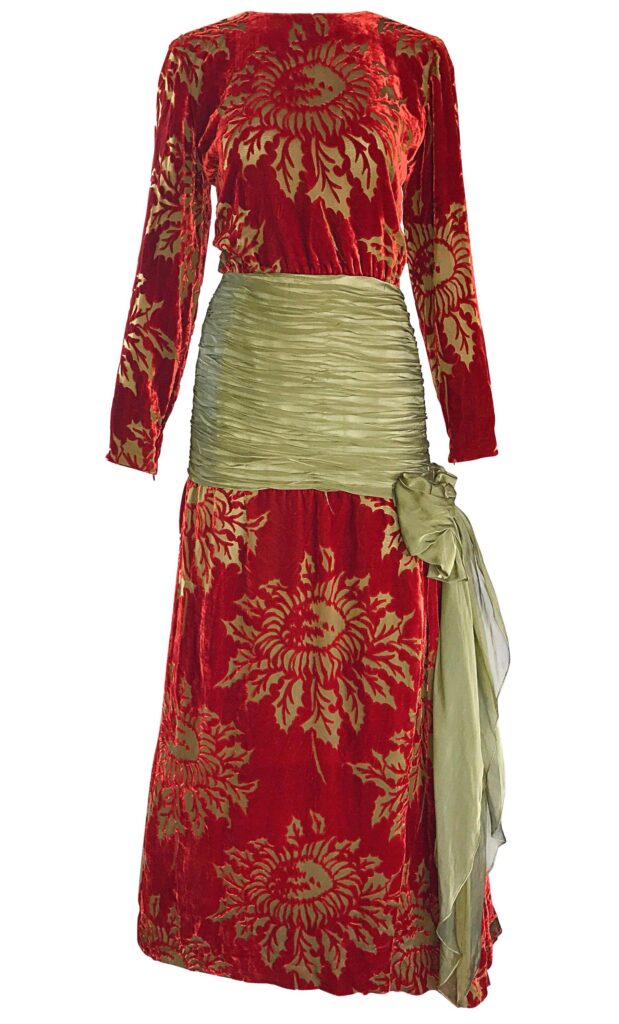
Dress by James Galanos in jacquard silk velvet and gold thread
When I was working on the creation of the museum, I kept a Bianchini-Férier sample that I particularly loved beside my computer. It combined gold threads and velvet. I did not yet know how I would incorporate it into the story, but there was something about the pattern that held my attention, so I kept it close at hand.
One day, while searching online, a dress by the great American couturier James Galanos appeared on my screen.
It featured exactly the same pattern as the sample lying beside my computer.
Returning to the archives, I found a photograph from a Paco Rabanne fashion show in which a model is wearing a monumental cape made from the same fabric, along with samples showing the different colourways. Everything matched. The fabric that had been quietly sitting beside me for months had suddenly found its dress.
Identifying a piece is only the beginning of the adventure
The next step is to contact its owner or seller, sometimes negotiate its acquisition, and then arrange its transport. Many of the dresses now held in the museum’s collection have travelled a very long way, particularly from the United States and Australia. Anything can happen in transit, take it from me. One of them even had to be rescued from a dog’s mouth…
Once the dress arrives in Lyon, the investigation continues. Its date of creation must be established, the couturier precisely identified, sources compared and its history documented. Finally, the piece must be inventoried, photographed, carefully packed and preserved under appropriate conditions until it can be presented to the public.
Each dress we rediscover adds another page to the history of the house.
It bears witness to an encounter between a couturier and a silk maker, between a silhouette and a material. It also reminds us that behind the great names of fashion are workshops, technicians, designers, weavers and an entire chain of expertise that has often remained invisible.
Julie Dodet, Exhibition Curator
BROCHIER SOIERIES, 130 YEARS OF SILK, GOLD AND SILVER
Exhibition from October 1, 2026
Musée Soieries Brochier
18 quai Jules Courmont, 69002 Lyon