

History and technique ofwoodblock printing
The techniques of printing on textile were first developed in the Far East. In Europe, this ancient skill flourished in the Middle Ages. But, as a method of embellishing cloth, it was gradually abandoned.
History
At the beginning of the 17th century, the French East India Company set off a major fashion craze when they imported the first block-printed fabrics from India. The bright, permanent colours of those printed Indian cottons made a great impression on the people of the time. The fabric was also remarkably light compared to materials with woven patterns. Its success knew no bounds and appealed to all social classes.
- XVII
In the early 17th century, the French East India Company, which had been set up by Colbert, unleashed a real fashion phenomenon when they imported the first block-printed fabrics from India. The bright, permanent colours of those printed Indian cottons made a great impression on the people of the time.
The fabric was also remarkably light compared to materials with woven patterns. Its success knew no bounds and furthermore it appealed to all social classes.The reaction of the Lyon silk manufacturers was determined by two basic factors.
- First, the strict regulations to which Lyon manufacturers were subject prevented them from responding to any new demand.
- Second, the manufacturers didn’t know how to use Indian dyes.
In the face of competition that they had no way of competing with, the Lyon silk workshops and the royal wool manufactories rebelled against it.
As early as 1686, the King’s Council of State prohibited the import, then the manufacture and even the wearing of garments made out of the Indian printed cotton. Even so, prohibition had the effect of encouraging a good deal of smuggling. - 1734
It wasn’t until 1734 that the secret of Indian cloth was cracked, thanks to Captain Beaulieu’s report on the printers of Pondicherry and also thanks to progress in the chemistry of dyes. In the face of persistent demand for it, countrywide permission to print was granted on 5 September 1759. A dozen workshops set up printing operations in Lyon.
But after that period of enthusiasm, the economic crisis that followed the collapse of the Empire led many manufacturers to close their workshops.
- XIX
In the 19th century, the process was taken up again in a particularly interesting application known as warp printing: the colours were applied with woodblocks to the warp threads of the silk, tied and held together by a first, temporary weave.
The final weave only took place when the printed warp was placed back on the loom.Direct printing onto fabric was also often done using engraved wooden plates or intaglio-engraved copper plates. Engraved copper cylinder printing, invented in 1783, could not be used for silk. The high cost of woodblock printing and its limited production capacity led to its being used only for short lengths of prestige material.
- 1920
The intensely creative period in the 1920s saw renowned artists such as Sonia Delaunay and Raoul Dufy actively collaborating with Lyon silk houses.
To produce their artistic creations and to compensate for the shortcomings of the earlier technique, the Lyonnais silk manufacturers sought to develop a new printing system that could be applied to all fabrics. It was a very old Japanese process that provided them with the beginnings of an answer: the stencil.

The technique
The production of printing plates takes place over several stages and involves a number of different people: the designer, the engraver, the foundryman, the chemist, and so on.
First of all, the designer makes a full-size gouache maquette.
The engraver breaks down the motif according to the number of colours it contains. One plate has to be made for each colour. By overlaying these blocks the motif is reproduced in its entirety.
The composition of the motif is also worked out again according to how much it needs to be enlarged, both in height and in width. This task of visually re-arranging the design’s proportions also falls to the engraver.
The engraver chooses the appropriate material for the job:
- relief wood blocks are used for small designs (entre 20 et 30 centimètres de hauteur de rapport)
- intaglio copper plates are used for large designs (plus de 40 centimètres de hauteur de rapport).
The engraver prepares the block. On the back of the block, they carve two small parallel cavities so that it can be held securely in the hand. On its smooth side, they transfer the lines of the original drawing using a piece of paper blackened with lampblack and oil. They then place the drawing they want to reproduce on the paper and draw all the outlines with a blunt-ended punch. Then, following the black line, they paint the surfaces that are to remain in relief with a diluted red pigment.
The block is then incised and all the uncoloured areas are hollowed out to a depth of 2-3 mm using a variety of sharp and percussive objects. The motif may need to be completed by inserting thin, curved or straight copper strips in order to match the precision of the lines in the original design. Once engraved, the block is fitted with pins on its 4 corners which will serve as guides during the printing process.
Once all the blocks have been carved (the number of blocks required depends on the number of colours), the design is checked:
The engraver makes a first test print on paper. This is called a proof print.
In the late eighteenth century, lead stereo plates appeared. They were made using the stereotype process, in which a lead alloy is poured into an engraved wooden mould, the matrix, to produce certain elements of the design, which are then fixed to a plate, called a stereo plate. Those elements can of course be produced in as many copies as required. The technique makes it possible to produce very intricate designs (sometimes 1 mm). As with engraved printing blocks, which are unique pieces, stereo plates can also be duplicated by the same process.
To print a design on silk,
- our printers begin by stretching the fabric evenly across the printing table using needles.
- They then prepare the inkpad, by steeping it evenly in the desired colour. The engraved side of the block is then impregnated with dye by pressing it onto the inkpad.
- The block is then gently placed onto the silk piece, starting with the pins in the corners that indicate the boundaries [délimitent les rapports] of the motif.
- Once the block has been placed on the fabric, it is struck two or three times with a mallet in order to apply rapid and even pressure.
The ink on the raised surfaces of the block dyes the silk. The process is repeated according to the number of colours (blocks) needed to produce the complete design..
We are proud of the fact that our workshop boasts more than 12,000 printing blocks, each one of which is a work of art in its own right. Some of the blocks are over 200 years old, and we still use them to create unique pieces in a special area of the workshop.

Welcome to the Brochier Soieries silk printing workshop

Practical information
The workshop is open to the public on Mondays and Fridays 9:30 am - 1:00 pm & 2:00 pm - 6:00 pm, on Tuesdays, Wednesdays and Thursdays 9:30 am - 1:00 pm & 2:00 pm - 6:30 pm, on Saturdays 9 am - 1:00 pm & 2:00 pm - 6 pm. Closed on April 6th; May 1st, 8th, 14th and 25th May; July 14th and August 15th; November 11th; December 24th (1 pm), December 25th; January 1st.
Contact details
julie.dodet@brochiersoieries.com
L’Atelier Brochier Soieries
33 rue romarin - 69001 Lyon
Map
Public transportation:
Metro line A and Line C | Hôtel de Ville station
Bus S1, A32, A71, C5, 9 | Hôtel de Ville station
Plan a journey
INTRODUCTIONS TO ART PRINTING
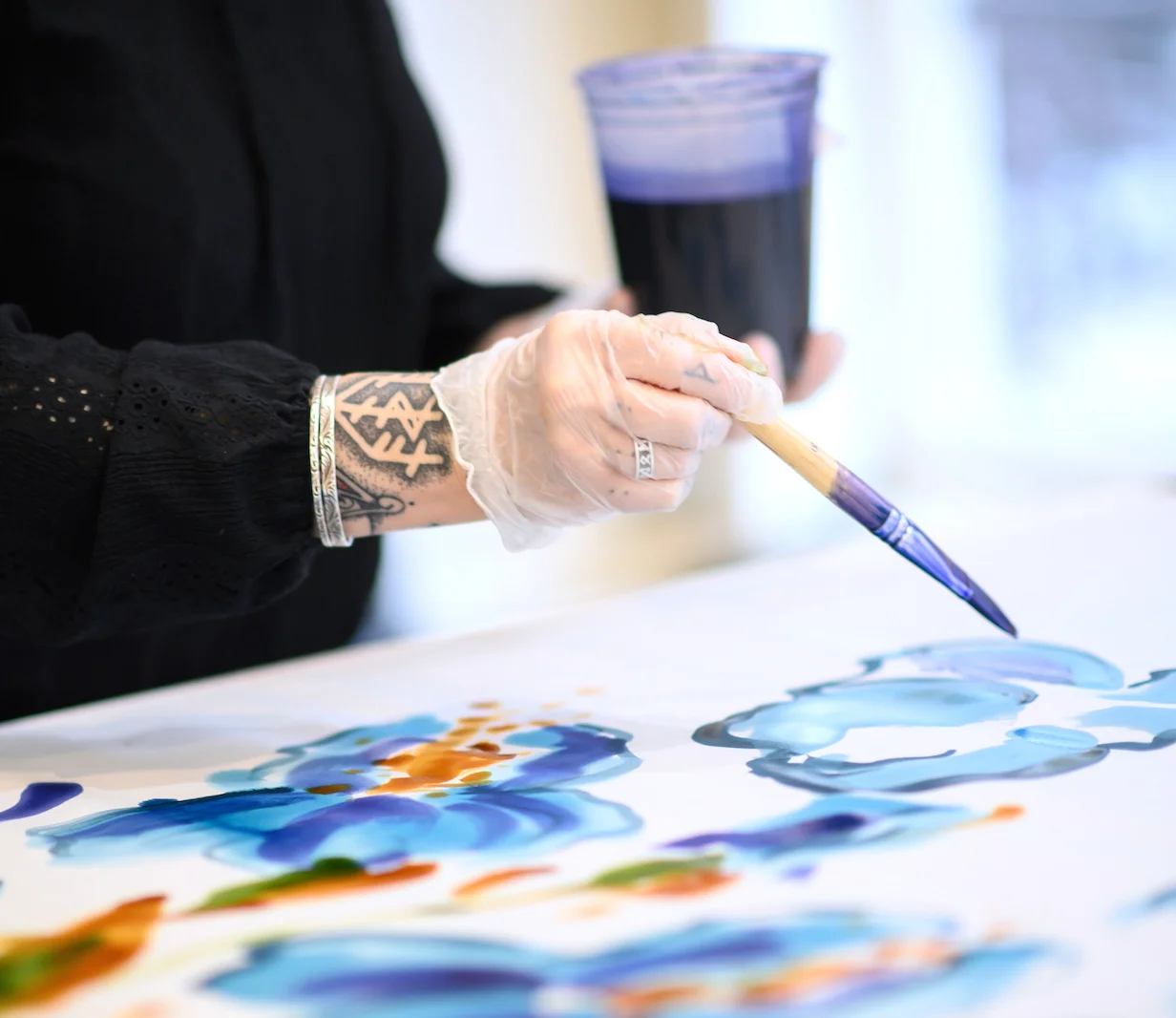
Introduction to painting on silk
Duration of the introductory lesson: 2h
Subject to reservation
140 € / per person
Venue : 33 rue romarin Lyon 1
Find out more about the Painting on silk introductory lesson
Our designer’s introduction to silk painting is a unique creative experience.
Over the course of two hours, you will discover silk painting techniques and create your own personalised silk square.
Anna will guide you through the creative process, providing you with inspiring textile designs, tools and materials. Seated in front of the long hand-painting tables on which the silk rolls are stretched, you’ll spend 2 hours discovering the secrets of a Lyonnais skill that was highly prized by the great couturiers of the 20th century.
This introductory course is available for groups of two or more, and can be adapted to your level, whether you are a beginner or an experienced painter. It’s the ideal opportunity to share a timeless moment with friends or family (children aged 8 and over).
Once the session is over, our team will complete the process by fixing your colors, washing and manufacturing your square. As soon as the process is complete, we’ll send the square to you by post anywhere in the world. A unique souvenir 100% lyonnais, 100% you!
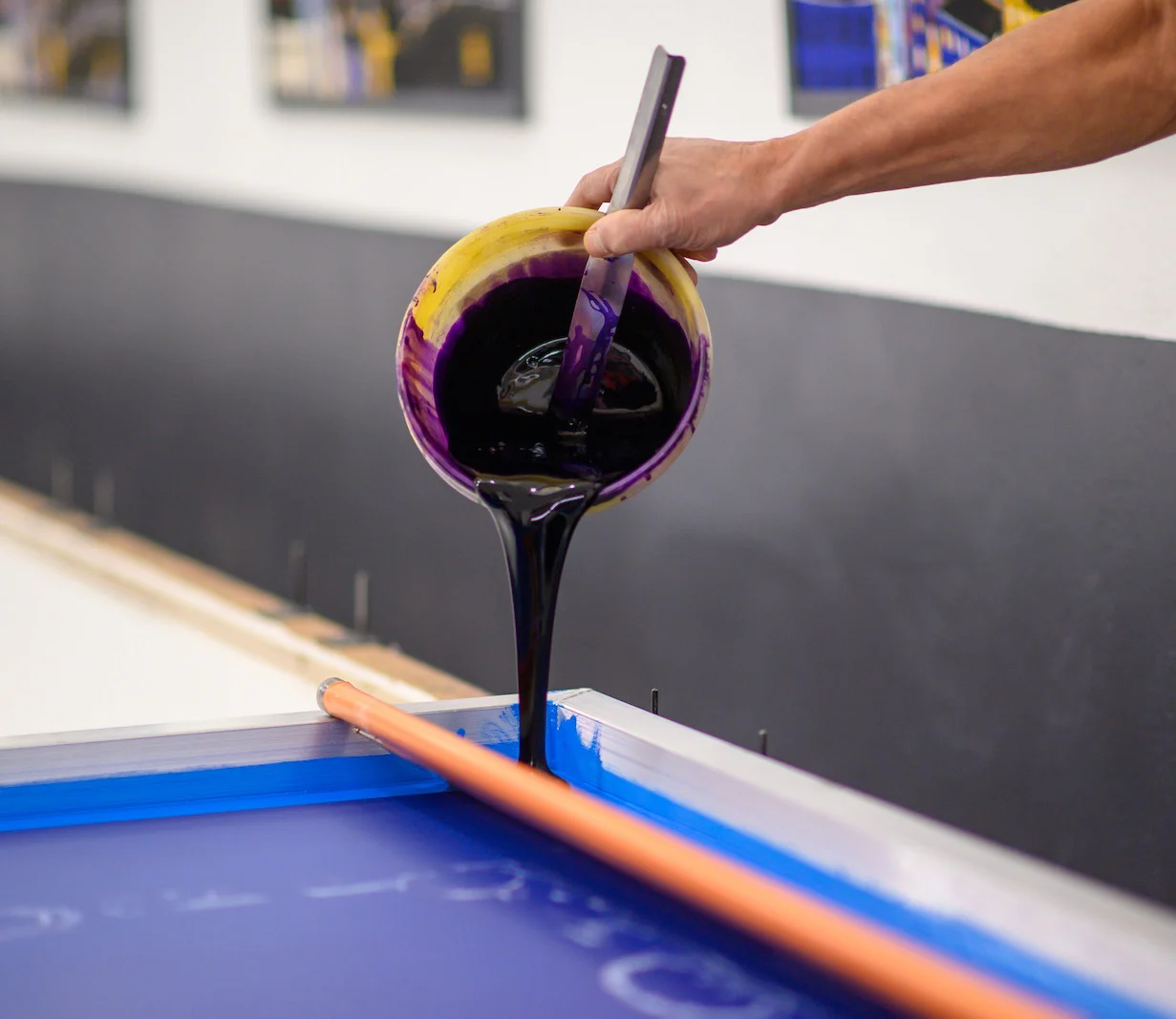
Introduction to flat-frame printing à la lyonnaise
Duration of the introductory lesson: 3h
Subject to reservation
250 € / per person
Venue : 33 rue romarin Lyon 1
Find out more about the Flat-frame printing à la lyonnaise introductory lesson
Our silk-printing workshop is the last workshop in France in operation to perpetuate by hand this traditional process invented in Lyon in 1920 and long used by Lyonnais manufactures for printing on fabric. With 3,000 frames, some of which date back to 1950, we can produce a wide variety of designs, combining tradition and modernity.
The introduction to flat-frame printing offered by our printers is a unique and creative experience.
Over the course of two hours, you’ll discover frame printing techniques “à la lyonnaise” and create your own personalized silk square. Seated in front of the long printing tables on which the silk rolls are stretched, our printers will share the secrets of a Lyonnais know-how so highly prized by the great couturiers of the 20th century.
Initiation is adapted to your level, whether you’re a beginner or experienced.
Once the session is over, our team will complete the process by fixing your colors, washing and manufacturing your square. As soon as the process is complete, we’ll send the square to you by post anywhere in the world. A unique souvenir 100% lyonnais, 100% you!
BOOK YOUR GUIDED TOUR
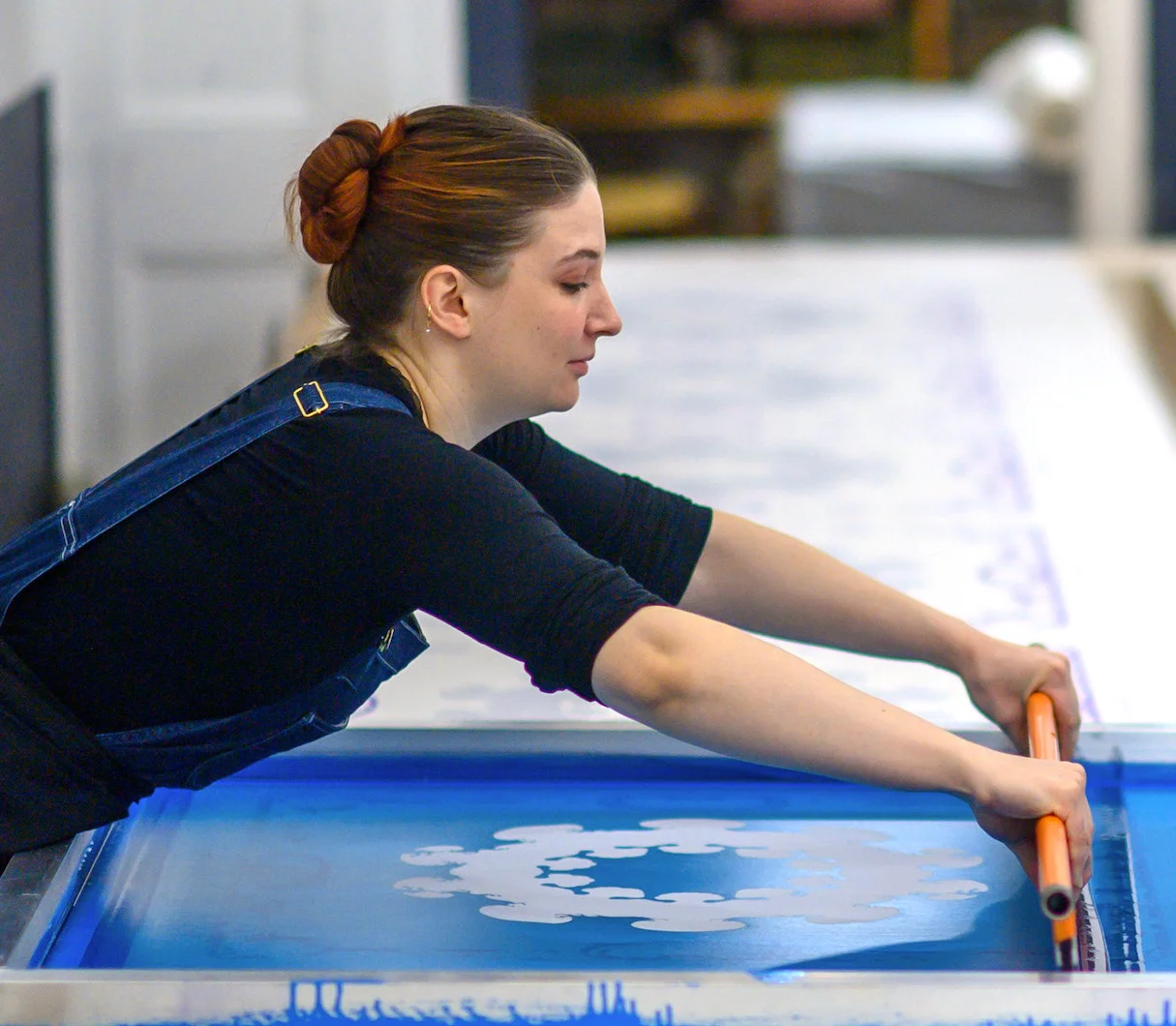
Find out more about the workshop guided tour
The Brochier Soieries workshop invites you to discover its traditional skills: frame printing “à la lyonnaise”, hand-painted silk velvet panne and block printing.
Our silk printing workshop is the last workshop in France still in operation to perpetuate by hand this traditional process, invented in Lyon in 1920 and long used by manufacturers to produce prints on fabric. With 3,000 frames, some dating back to 1950, we produce a wide variety of graphics, combining tradition and modernity.
During your visit, our printers will share the secrets of Lyon’s expertise, so highly prized by the great couturiers of the 20th century.
You’ll discover the techniques of frame printing “à la lyonnaise” and block printing: qualities of silk fabrics, installation of silk rolls on long printing tables, cooking of colors, smoothness of colored pastes, printing, drying and fixing. Upstairs, you’ll be invited to a demonstration of hand-painting on velvet panne, a renowned specialty of Lyon!
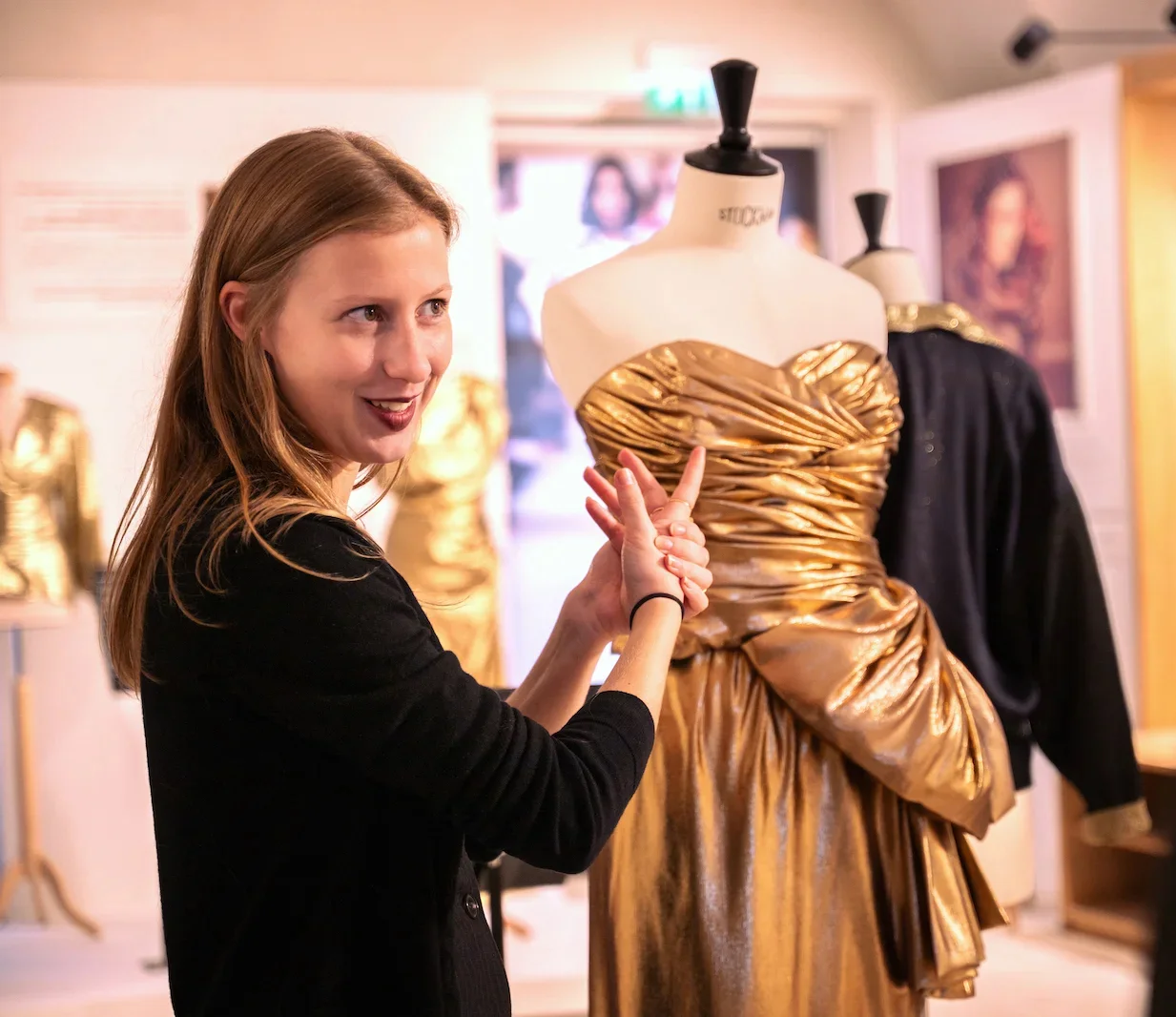
Brochier Soieries Museum
Location : 18 quai Jules Courmont Lyon 2
Find out more about the exhibition "Brochier Soieries, 130 years of Silk, Gold an d Silver"
To mark its new exhibition, Brochier Soieries: 130 Years of Silk, Gold and Silver, the Musée Soieries Brochier invites you to step behind the scenes of a Lyon silk house that is still active today.
130 Years of Silk, Gold and Silver
One of Brochier Soieries’ signature fabrics, gold lamé provides the guiding thread for the new exhibition. From its origins and development for leading couturiers to its artistic splendour and innovative applications, discover 130 years of creativity, craftsmanship and research.
Through fabrics, archives, drawings and couture garments, the tour explores Brochier Soieries’ long-standing connections with leading figures in fashion, design and art.
A Lyon Silk House Still Active Today
Founded in Lyon in 1890, Brochier Soieries continues to uphold the expertise and craftsmanship of Lyon’s silk-making tradition. Today, the House creates and produces fabrics for fashion, art, design and innovative applications.
An 1840 Jacquard Loom Still in Working Order
At the heart of the museum stands an authentic Jacquard loom dating from 1840. Restored and still in working order, it offers a fascinating insight into the weaving techniques that made Lyon’s silk industry world-renowned.
Weaving demonstrations are available on request, giving visitors the opportunity to see the loom in action and observe the skills of the weaver.
Discover Our Printing Workshops
Continue your exploration of the House’s craftsmanship with a visit to the Brochier Soieries printing workshops. Here, you can watch our printers at work and discover the different stages involved in creating our silk scarves.
The workshops are open to visitors during opening hours.
Duration: 1 hour | Location: 18 quai Jules Courmont, Lyon 2nd district (entrance via the quay)
INTRODUCTIONS TO ART PRINTING

Introduction to painting on silk
Duration of the introductory lesson: 2h
Subject to reservation
160 € / per person
Venue : 33 rue romarin Lyon 1
Find out more about the Painting on silk introductory lesson
Our designer’s introduction to silk painting is a unique creative experience.
Over the course of two hours, you will discover silk painting techniques and create your own personalised silk square.
Philippine will guide you through the creative process, providing you with inspiring textile designs, tools and materials. Seated in front of the long hand-painting tables on which the silk rolls are stretched, you’ll spend 2 hours discovering the secrets of a Lyonnais skill that was highly prized by the great couturiers of the 20th century.
This introductory course is available for groups of two or more, and can be adapted to your level, whether you are a beginner or an experienced painter. It’s the ideal opportunity to share a timeless moment with friends or family (children aged 8 and over).
Once the session is over, our team will complete the process by fixing your colors, washing and manufacturing your square. As soon as the process is complete, we’ll send the square to you by post anywhere in the world. A unique souvenir 100% lyonnais, 100% you!

Introduction to flat-frame printing à la lyonnaise
Duration of the introductory lesson: 3h
Subject to reservation
2 to 5 people
250 € / per person
Venue : 33 rue romarin Lyon 1
Find out more about the Flat-frame printing à la lyonnaise introductory lesson
Our silk-printing workshop is the last workshop in France in operation to perpetuate by hand this traditional process invented in Lyon in 1920 and long used by Lyonnais manufactures for printing on fabric. With 3,000 frames, some of which date back to 1950, we can produce a wide variety of designs, combining tradition and modernity.
The introduction to flat-frame printing offered by our printers is a unique and creative experience.
Over the course of two hours, you’ll discover frame printing techniques “à la lyonnaise” and create your own personalized silk square. Seated in front of the long printing tables on which the silk rolls are stretched, our printers will share the secrets of a Lyonnais know-how so highly prized by the great couturiers of the 20th century.
Initiation is adapted to your level, whether you’re a beginner or experienced.
Once the session is over, our team will complete the process by fixing your colors, washing and manufacturing your square. As soon as the process is complete, we’ll send the square to you by post anywhere in the world. A unique souvenir 100% lyonnais, 100% you!